Best Water Softener Salts for Softer Water and Protected Plumbing
Choosing the right salt is essential for maximizing the efficiency and lifespan of a water softening system. The options below cover a range of needs—from high-capacity packs to rust-defense blends and solar-salt choices. This guide highlights four commonly used salts, with practical considerations like salt form, capacity, iron tolerance, and maintenance. Use the buying guide to compare dissolution behavior, compatibility with your softener, and long-term value for your household.
| Product | Brand | Contents | Key Benefit |
|---|---|---|---|
| (3 Pack) Clean And Protect Water Softener Salt | Generic | 120 lbs total | Extends appliance life; reduces hard water buildup |
| 2 Pack Water Softener Salt Pellets – Clean and Protect Plus Rust Defense | Generic | 80 lbs total | Removes iron; reduces rust stains; protects pipes |
| Generic (Morton) Clean And Protect Salt Pellets | Morton / Generic | 240 lbs total | Cleaner water; reduces mineral buildup |
| Diamond Crystal Solar Naturals Salt | Diamond Crystal | 50 lbs | Solar salt option; extra coarse texture |
Clean And Protect Salt For Water Softeners

This salt supply provides a total of 120 pounds across three bags, designed to soften hard water while limiting mineral buildup in appliances and piping. The Clean and Protect formulation aims to keep water-using equipment operating efficiently by reducing scale formation. Softer water improves cleaning performance and the feel of hair and skin after bathing. It is compatible with a broad range of standard ion-exchange softeners, making it a versatile option for many households facing persistent hardness.
- Total weight: 120 pounds across three bags.
- Enhances cleaning: Softer water improves dishwashing performance and bathing experience.
- Pipe and appliance protection: Reduces hard water buildup to support longevity and efficiency.
Salt Pellets With Rust Defense
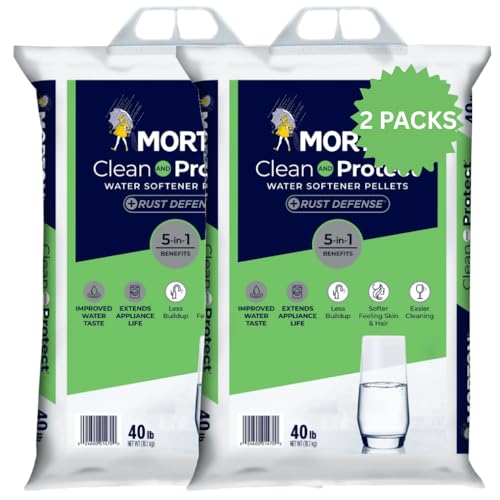
This two-pack provides 80 pounds of Clean and Protect Plus Rust Defense salt pellets, formulated to address iron-related issues in hard water. By reducing iron content, it can improve taste and odor while minimizing rust staining on fixtures. Regular use helps shield plumbing and appliances from mineral buildup that can impede flow and efficiency. The pellets are designed to dissolve evenly in most residential softeners, supporting steady, reliable soft-water production over time.
- Iron removal for better taste and fewer odors.
- Reduces rust stains on sinks, tubs, toilets, and laundry.
- Protects plumbing and appliances by limiting mineral buildup.
Morton Clean And Protect Salt Pellets

Six bags of 40-pound Morton Clean and Protect pellets offer a high-capacity option for households with higher water hardness or larger families. The Morton formulation aims to keep soft-water production steady while reducing mineral buildup in pipes and appliances. Softer water supports better cleaning results and can help glassware, dishes, and fixtures stay sparkling with less effort. Morton is known for reliable pellet performance and good dissolution, contributing to predictable soft-water cycles and improved equipment longevity.
- Six bags of 40 lbs each (240 lbs total).
- Softer water enhances cleaning and reduces scale in fixtures and appliances.
- Reliable pellet performance with steady dissolution for consistent soft-water cycles.
Diamond Crystal Solar Naturals Salt

Diamond Crystal Solar Naturals Salt is a solar salt option packaged in a 50-pound bag. The product listing notes its solar salt formulation, which can be a practical choice for systems that operate efficiently with solar salt blends. The extra coarse texture may suit certain softeners that are designed to dissolve larger salt crystals at a controlled rate. Before purchasing, confirm compatibility with your specific softener model and regeneration schedule to optimize performance and minimize waste.
- 50-pound bag for practical replacement cycles.
- Solar salt option with extra coarse texture.
- Compatibility with your softener’s dissolution and regeneration schedule matters for peak performance.
Buying Guide
Salt Type And Form
Salt form affects dissolution rate and compatibility with your softener. Pelletized salts typically dissolve quickly and evenly, helping maintain steady soft-water production. Solar salts, including extra coarse varieties, may suit units designed for larger, slower dissolving salts. Check your softener’s manual to confirm whether pellets, solar salt, or a hybrid option is recommended.
Iron And Rust Considerations
Hard water often contains iron, which can cause taste, odor, and staining issues. If your water supply has high iron levels, consider blends labeled with rust defense or iron-removal claims. Such options can reduce rust stains on fixtures and help protect appliances by limiting mineral buildup that can accelerate wear.
Capacity And Coverage
Bag counts and total weight determine how long a supply will last. Larger households or higher water hardness typically require greater total weight (for example, 240 pounds vs. 120 pounds). Evaluate your household’s water usage, hardness level, and the size of your softener’s brine tank to estimate replacement intervals and overall value.
Quality And Brand Reputation
Well-known brands with consistent dissolution performance can reduce maintenance time and frustration. Look for product specifications that confirm salt type, texture, and recommended softener compatibility. Reading product reviews and checking the dissolution behavior in similar systems can help gauge long-term reliability.
Compatibility With Your System
Not all salts work optimally with every softener. Some units require pelletized salt, while others can use solar salt effectively. Verify your model’s regeneration schedule, salt type compatibility, and any warranty implications before purchasing a large supply. Mismatched salt can increase residue buildup or shorten equipment life.
Storage And Handling
Store salt in a dry, ventilated area to prevent caking and moisture absorption. Humidity and damp conditions can cause clumping and reduce shelf life. Keep bags sealed and elevated off the floor to protect from spills and moisture exposure. Proper storage helps maintain salt quality and ease of use over time.
Cost Considerations And Value
While price per pound is a common decision factor, it should be weighed against capacity, dissolution performance, and maintenance needs. Larger, multi-bag formats may offer better long-term value for households with high consumption, but consider storage space and replacement scheduling. Balanced evaluation of unit price, total weight, and expected service life leads to better overall value.